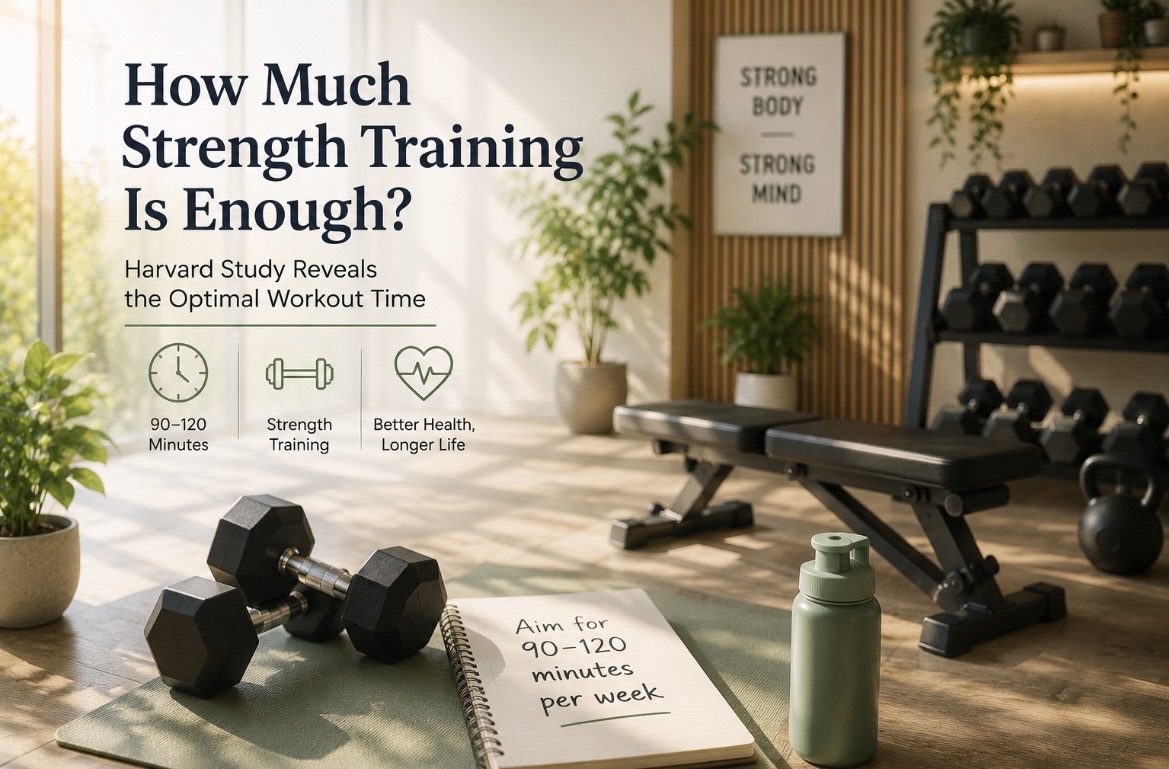
Is More Strength Training Always Better? A Harvard Study Found the “Sweet Spot”

When people start exercising to improve their health, many of them have the same thought:
“The more I work out, the healthier I’ll be.”
But according to a recent study, that’s not necessarily true.
Researchers found that 90 to 120 minutes of strength training per week may be the ideal amount for better health and a longer life.
A 30-Year Study of More Than 140,000 People
Researchers at Harvard University analyzed the exercise habits and health outcomes of more than 140,000 adults over a period of up to 30 years.
The study included not only weight training at the gym but also bodyweight exercises such as push-ups, squats, and lunges as forms of strength training.
It also examined aerobic activities—including walking, running, swimming, and cycling—to better understand how different types of exercise relate to the risk of death.
The “Sweet Spot” Is 90–120 Minutes Per Week
One of the most interesting findings was the amount of time spent on strength training.
People who performed 90 to 120 minutes of strength training each week had a lower risk of death than those who did not.
Specifically, they showed:
- A 13% lower risk of death from all causes
- A 19% lower risk of death from cardiovascular disease
- A 27% lower risk of death from neurological diseases
Interestingly, the benefits appeared to level off after 120 minutes per week.
In other words, spending more time on strength training did not lead to additional health benefits.
The Benefits Were Even Greater When Combined With Cardio
The study also found that people who combined strength training with regular aerobic exercise experienced even greater health benefits.
Those who regularly included activities such as walking, running, or cycling alongside strength training had an even lower risk of death.
This suggests that combining both strength training and cardio may be the most effective approach for long-term health.

Consistency Matters More Than Doing More
Perhaps the biggest takeaway from this study is surprisingly simple.
It’s not about exercising as much as possible—it’s about exercising consistently for the right amount of time.
Even if you have a busy schedule, 20 to 30 minutes of strength training a day can easily add up to the recommended 90 to 120 minutes per week.
For example:
- Strength training for 30–40 minutes on Monday, Wednesday, and Friday
- Or 20–25 minutes each weekday
Either approach is enough to reach the range suggested by the study.
One Important Thing to Remember
Although this was a large study that followed participants for many years, it was still an observational study.
That means it cannot prove that strength training directly reduces the risk of death.
It’s also possible that people who consistently perform strength training tend to have healthier lifestyles overall, which may have contributed to the results.
Final Thoughts
When it comes to exercise, more isn’t always better.
Working out consistently within a range that allows your body to recover may be far more beneficial than simply exercising longer.
Based on this study, aiming for 90 to 120 minutes of strength training each week, along with regular aerobic exercise such as walking or running, appears to be a practical and effective way to support your long-term health.
If you’ve been feeling pressured to spend more and more time exercising, it may be worth shifting your focus from “How long should I work out?” to “Am I being consistent?”